Asus ZenBook Duo vs MacBook Pro M4 – Which Premium Laptop Makes Sense?
Disclosure: This post contains affiliate links. LaptopVoyager.com participates in the Amazon Associates Program and may earn commissions on qualifying purchases, at no extra cost to you.
Last Updated: January 2026
Choosing between the Asus ZenBook Duo and the MacBook Pro M4 comes down to how you actually work day to day. Both sit firmly in the premium category, but they take very different approaches to productivity. One prioritizes multitasking with dual screens, while the other focuses on performance efficiency, stability, and long-term reliability.
👉 If you’re comparing premium laptops across brands, our best brand laptop computers guide helps place both options in the wider premium landscape.
💰 Check Price & Availability
View on Amazon – ASUS ZenBook Duo Laptop (Dual 14” OLED, Core Ultra 9, 32GB RAM, 1TB SSD)
View on Amazon – Apple MacBook Pro 14” with M4 Pro (12-core CPU, 16-core GPU, 24GB RAM, 512GB SSD)
📋 Quick-View Comparison List
Best for Multitasking & Workflow Flexibility: Asus ZenBook Duo – dual OLED screens make managing multiple apps far easier.
Best for Sustained Performance & Longevity: MacBook Pro M4 – efficient Apple silicon paired with long macOS support.
Best Display Accuracy: MacBook Pro M4 – Liquid Retina XDR delivers exceptional brightness and contrast.
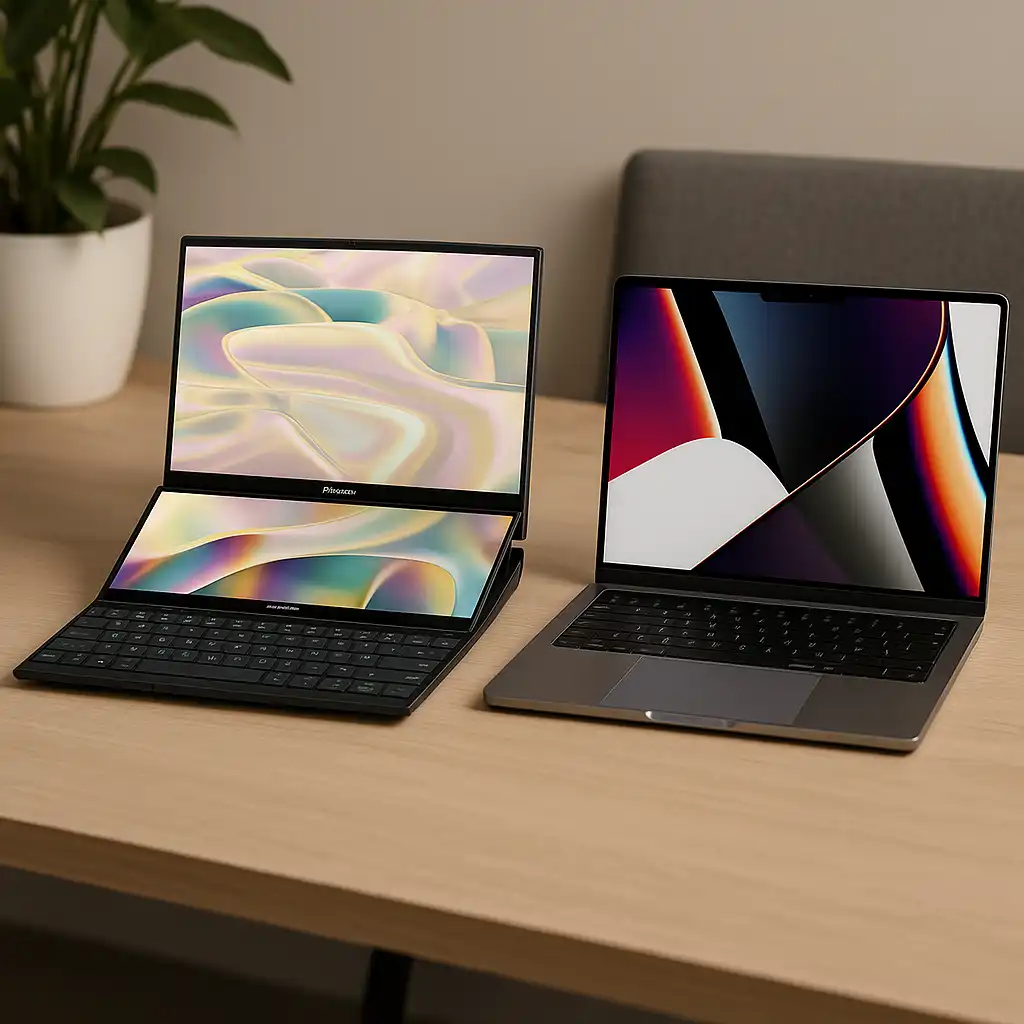
Best Built-In Multi-Screen Setup: Asus ZenBook Duo – detachable keyboard and second touchscreen built directly into the design.
🔍 Performance & Everyday Speed
The MacBook Pro M4 is designed for users who need consistent performance over long work sessions. With the M4 Pro chip, it handles creative workloads, development tasks, and heavy multitasking smoothly while staying quiet and power-efficient.
The Asus ZenBook Duo uses Intel’s Core Ultra 9 processor paired with 32GB of RAM, which gives it plenty of headroom for productivity and creative apps. While it may not match Apple’s efficiency under extended loads, it feels fast and responsive in everyday use—especially when work is spread across two screens.
🔍 Display Experience & Productivity
This is where the ZenBook Duo clearly stands out. Its dual 14-inch OLED touchscreens allow you to keep tools, reference material, chats, or timelines visible without connecting an external monitor. For spreadsheet work, research, or editing timelines, that extra screen space can noticeably improve workflow.
The MacBook Pro M4 takes a different approach with a single high-end display. Its Liquid Retina XDR panel offers excellent brightness, contrast, and color accuracy, making it a strong choice for photo, video, and design work where visual precision matters most.
🔍 Portability & Battery Life
Despite its unique design, the ZenBook Duo remains reasonably portable, though the dual screens and detachable keyboard add some weight. Battery life is solid for a premium Windows laptop, but it’s better suited for desk-based or mixed-use setups than all-day unplugged travel.
The MacBook Pro M4 is easier to rely on when you’re away from an outlet. Thanks to Apple’s efficiency-focused hardware and macOS optimization, it typically lasts much longer in everyday use, which makes it a safer choice for mobile or travel-heavy workflows.
🔍 Software Ecosystem & Longevity
macOS plays a big role in the MacBook Pro M4’s long-term appeal. Apple typically provides software updates for many years, helping its laptops stay secure and usable well into the future.
The ZenBook Duo runs Windows 11, offering broader software compatibility and flexibility, especially for users tied to Windows-only tools. That openness is a major advantage, though long-term optimization can vary more than on Apple’s tightly controlled ecosystem.
🔍 Which One Is the Better Choice?
The Asus ZenBook Duo suits users who value multitasking and screen space above everything else. If your workflow benefits from seeing multiple apps at once without external monitors, its dual-screen design can be a real productivity boost.
The MacBook Pro M4 is better suited for users who prioritize performance consistency, battery efficiency, and long-term reliability. It’s a strong fit for professionals and creators who want a premium laptop that holds up well over time.
📌 Key Takeaways
- The ZenBook Duo is built for multitaskers who benefit from dual screens without external monitors.
- The MacBook Pro M4 focuses on performance stability, efficiency, and long-term software support.
- Display priorities differ: screen quantity vs display precision.
- Battery life favors the MacBook Pro M4, especially for mobile users.
- The better choice depends on whether workflow flexibility or long-term performance matters more.
🟢 FAQs
Q: Is the Asus ZenBook Duo better than the MacBook Pro M4 for productivity?
A: It depends on your workflow. The ZenBook Duo excels at multitasking, while the MacBook Pro M4 prioritizes sustained performance and efficiency.
Q: Which laptop is better for creative work?
A: The MacBook Pro M4 suits users who need color accuracy and consistent power, while the ZenBook Duo works well for workflows that benefit from extra screen space.
Q: Can the dual-screen setup replace an external monitor?
A: For many users, yes. The second screen can handle tools, timelines, or reference content without needing another display.
Q: Which laptop is likely to last longer overall?
A: The MacBook Pro M4 typically benefits from longer software support, which can extend its usable lifespan.
✅ Conclusion
Both laptops offer premium experiences, but they’re built for different priorities. The Asus ZenBook Duo emphasizes multitasking and workflow flexibility, while the MacBook Pro M4 focuses on efficiency, performance stability, and longevity. The right choice comes down to whether extra screen space or long-term performance better fits how you work.