ADATA vs Transcend External Hard Drive – Key Differences
Disclosure: This post contains affiliate links. LaptopVoyager.com participates in the Amazon Associates Program and may earn commissions on qualifying purchases, at no extra cost to you.
Last Updated: September 2026
ADATA and Transcend both offer portable external hard drives designed for laptop storage, backups, and moving large files between computers. However, their product ranges differ in areas such as rugged protection, software features, portability, and available designs.
This guide compares ADATA vs Transcend external hard drives based on specifications, durability, connectivity, storage capacity, software, and everyday laptop use.
👉 For a broader look at portable storage options, see Difference Between SSD and HDD External Hard Drives.
📌 Key Takeaways
- ADATA and Transcend both offer portable HDDs with USB 5Gbps connectivity on current models.
- Rugged models from both brands are designed to provide additional protection against physical impacts.
- ADATA’s HD710 Pro adds IP68-rated dust and water protection.
- Transcend’s rugged StoreJet models use multi-stage shock-protection systems.
- Transcend provides software tools such as Transcend Elite and RecoveRx for supported drives.
- Storage capacities and physical dimensions vary by model.
- The right option depends more on the specific drive and intended use than the brand name alone.
🔍 What Are ADATA External Hard Drives?
ADATA produces portable external HDDs ranging from slim everyday storage models to rugged drives designed for more demanding environments.
The HV620S, for example, emphasizes portability. ADATA specifies capacities of 1TB, 2TB, and 4TB, with the 1TB and 2TB versions measuring 11.5 mm thick and weighing 152 grams.
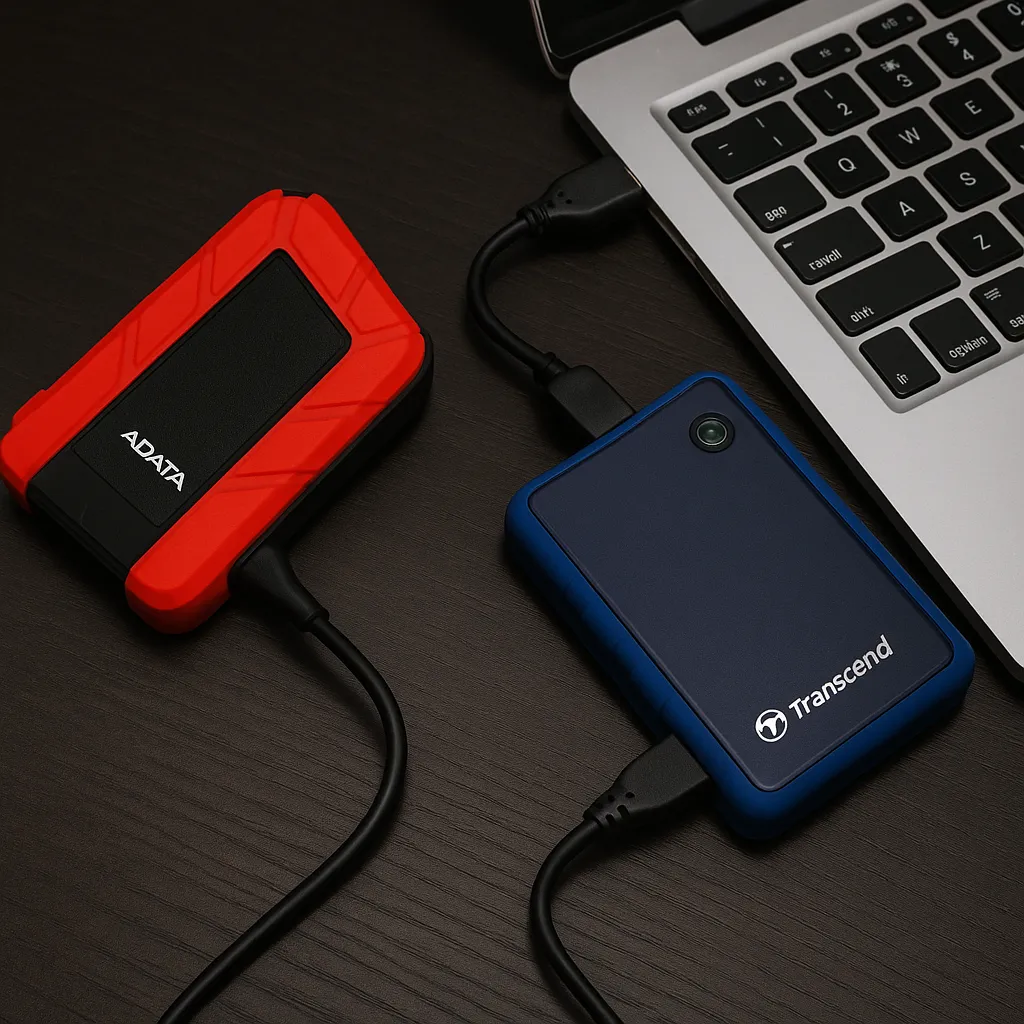
ADATA also offers more rugged designs such as the HD710 Pro. This series is designed around additional resistance to water, dust, and physical impacts.
The range therefore covers different priorities, from compact laptop storage to drives intended for travel and more demanding working conditions.
🔍 What Are Transcend External Hard Drives?
Transcend’s StoreJet family similarly includes portable external hard drives for backups, file storage, and transporting data.
Models such as the StoreJet 25M3 emphasize physical protection. According to Transcend, the 25M3 uses a three-stage shock-protection system consisting of a silicone rubber case, internal shock-absorbing suspension damper, and reinforced casing.
Transcend also offers StoreJet models with different designs and capacities, including 1TB, 2TB, and 4TB configurations in parts of its current portable HDD range.
Software support is another part of the Transcend ecosystem, with utilities available for functions such as backup management and data recovery.
🔍 ADATA vs Transcend: Main Differences
ADATA and Transcend compete in many of the same portable-storage categories, so the differences depend heavily on the models being compared.
ADATA offers both slim portable drives and heavily protected rugged models. Transcend’s StoreJet range similarly includes standard and ruggedized designs.
For example, an ADATA HV620S and a Transcend StoreJet 25M3 serve somewhat different priorities even though both are portable hard drives. The HV620S emphasizes a slim enclosure, while the StoreJet 25M3 places greater emphasis on shock protection.
Comparisons should therefore be made between equivalent models rather than assuming every ADATA or Transcend drive has the same characteristics.
🔍 Durability and Shock Protection
Durability is particularly important when an external hard drive will regularly travel with a laptop.
Transcend specifies a three-stage shock-protection system for the StoreJet 25M3. The design combines an external silicone rubber case, internal suspension damper, and reinforced casing.
ADATA takes a similar rugged approach with models such as the HD710 Pro, but adds protection against environmental exposure as well as impacts.
For ordinary desk use, these additional protective features may be less important. For frequent travel, field work, or carrying the drive in a laptop bag, enclosure protection can become a more significant consideration.
🔍 Water and Dust Protection
Water and dust resistance is one area where specifications can differ considerably between external hard drives.
ADATA specifies IP68 protection for the HD710 Pro when its USB port cover is properly closed. This makes the model particularly relevant when resistance to dust and water exposure is a priority.
Not every ADATA drive has this protection, however. Slim models such as the HV620S are designed around portability rather than the same rugged environmental sealing.
Likewise, Transcend’s shock-resistant StoreJet designs should not automatically be assumed to have the same water and dust protection as an IP68-rated drive.
Check the protection rating of the specific model rather than relying on the brand alone.
🔍 Connectivity and Transfer Speeds
Current portable HDDs from both companies use USB interfaces capable of considerably more bandwidth than the mechanical hard drive itself normally requires.
ADATA specifies USB 3.2 Gen 1, now also described as USB 5Gbps, for models such as the HV620S.
Transcend lists USB 3.1 Gen 1, also a 5Gbps interface, for StoreJet models including the 25M3 and 25H3.
The interface specification does not mean the mechanical hard drive will transfer files at 5Gbps. Actual performance is limited by the HDD mechanism, file sizes, computer, interface, and workload.
For users who prioritize much higher transfer performance, an external SSD may be more appropriate than either portable HDD.
👉 See Best External SSD for Gaming Laptops for examples of faster solid-state external storage.
🔍 Storage Capacity
Both brands provide multiple storage capacities, although availability depends on the model.
ADATA specifies the HV620S in 1TB, 2TB, and 4TB versions. Rugged ADATA models may be available in different capacity combinations.
Transcend currently lists StoreJet 25M3 and StoreJet 25H3 models with capacities including 1TB, 2TB, and 4TB.
A larger drive can make sense for video libraries, system backups, photos, and other large collections. Smaller capacities may be sufficient when the drive is mainly used to move documents or maintain secondary copies of important files.
Capacity should therefore be chosen according to the amount of data being stored rather than the manufacturer alone.
🔍 Portability and Size
Physical dimensions can matter when an external hard drive is carried alongside a laptop.
ADATA’s HV620S is specifically designed as a slim portable drive. ADATA lists the 1TB and 2TB versions at 115 × 78 × 11.5 mm and 152 grams.
Rugged drives are generally bulkier because protective materials are added around the internal hard drive.
Transcend’s shock-resistant StoreJet models similarly use additional casing and cushioning to protect the drive.
A slim model may therefore be more convenient for a laptop sleeve or compact bag, while a rugged model trades some compactness for additional physical protection.
🔍 Backup and Software Features
Software support is another difference worth considering.
Transcend provides utilities including Transcend Elite and RecoveRx for supported StoreJet drives. Transcend Elite provides data-management and backup functions, while RecoveRx is designed for attempting recovery of deleted files from supported storage devices.
Some StoreJet models also incorporate a physical one-touch backup button that works with supported software.
ADATA provides its own software ecosystem for supported storage products. For example, ADATA lists Backup ToGo software for the HV620S on Windows.
Software should not be treated as a substitute for a proper backup strategy. Important files are safer when multiple copies are maintained rather than relying on a single external hard drive.
🔍 ADATA HD710 Pro vs Transcend StoreJet
The ADATA HD710 Pro and rugged Transcend StoreJet models illustrate the different approaches taken by the two brands.
The HD710 Pro places particular emphasis on environmental protection, including its IP68 dust- and water-resistance specification.
Transcend’s StoreJet 25M3 emphasizes its three-stage shock-protection system and integration with Transcend’s software tools.
Both approaches can be useful, but they address somewhat different priorities.
The ADATA design may be relevant when water and dust exposure are major concerns. A rugged StoreJet may appeal to users who prioritize shock protection and Transcend’s backup and recovery software ecosystem.
🔍 ADATA vs Transcend for Laptop Backups
Either brand can provide suitable portable HDD storage for laptop backups when the drive’s capacity and interface meet the user’s requirements.
For a drive that will remain mostly on a desk, a slim conventional portable HDD may provide sufficient protection while taking up less space.
A rugged drive can make more sense when storage regularly travels in a backpack, camera bag, or work case.
The external drive should not be the only copy of important files. Hardware can fail regardless of brand, so critical data should ideally exist in more than one location.
🔍 Which External Hard Drive Is Better for Travel?
Travel places different demands on storage than stationary desk use.
A slim drive reduces bulk, while a rugged enclosure can provide additional protection against impacts during transport.
ADATA models such as the HD710 Pro add environmental protection for situations where exposure to dust or water is a concern. Transcend’s rugged StoreJet models emphasize multi-layer shock protection.
The most appropriate design therefore depends on whether compact size, impact resistance, or environmental protection is the greater priority.
🔍 ADATA vs Transcend: Which Should You Choose?
Neither brand is automatically the right choice for every laptop user.
An ADATA external hard drive may make sense when:
- IP-rated water and dust protection is important
- A rugged HD710-series design matches the intended environment
- A slim ADATA model better suits a compact laptop setup
- The available capacity and interface meet your storage requirements
A Transcend external hard drive may make sense when:
- Multi-stage shock protection is a priority
- Transcend Elite or RecoveRx software is useful for your workflow
- A one-touch backup feature is useful on a supported model
- A StoreJet configuration provides the capacity and portability you need
Compare the specifications of the individual drives rather than choosing solely according to the manufacturer.
🟢 FAQs
Q: Is ADATA better than Transcend for external hard drives?
Neither brand is universally better. ADATA and Transcend offer different portable and rugged models, so the better fit depends on capacity, protection, size, connectivity, and software requirements.
Q: Are ADATA external hard drives waterproof?
Some rugged ADATA models are designed with water resistance. The HD710 Pro, for example, carries an IP68 rating under the conditions specified by ADATA. This should not be assumed for every ADATA external drive.
Q: Are Transcend external hard drives shock resistant?
Some are. Transcend specifies a three-stage shock-protection system for models such as the StoreJet 25M3.
Q: Are ADATA and Transcend external hard drives fast?
Both companies offer portable HDDs using USB 5Gbps-class interfaces, but mechanical hard drives cannot use the full theoretical bandwidth of those interfaces. External SSDs generally provide substantially higher transfer performance.
Q: Is an external HDD good for laptop backups?
External HDDs can provide large storage capacities at relatively low cost and are commonly used for backups. Important data should still be stored in multiple locations rather than on only one external drive.
Q: Should I choose a rugged external hard drive?
A rugged model can be useful when the drive is frequently transported or used in environments where bumps, drops, dust, or water exposure are greater concerns. A standard slim drive may be sufficient for primarily stationary use.
✅ Conclusion
ADATA and Transcend both offer external hard drives suitable for laptop backups, file storage, and portable data. The most important differences appear at the individual model level rather than simply between the two brands.
ADATA’s range includes slim portable drives as well as rugged models such as the HD710 Pro with IP68-rated protection. Transcend’s StoreJet range includes rugged designs with multi-stage shock protection and access to software tools such as Transcend Elite and RecoveRx.
For laptop users, the most useful comparison is therefore based on capacity, physical protection, portability, connectivity, and software features. A rugged model may be appropriate for frequent travel, while a slimmer conventional HDD may be sufficient for routine desk-based backups.